|
How to choose quality
flatware
First things first.
Quality flatware comes at a
premium and is defined by the design (including weight and
feel), quality of production and materials, hand finish and
genuine attractiveness. I prefer flatware from those countries
and companies with a long tradition and proven record of
manufacturing in the country of origin – England, Germany, France and
Italy, but that's purely a personal view.
Much of the current cheaper and
not so cheap flatware on the market is made in Asia, especially
those of the larger brands.
Good quality flatware is available in four types
– stainless steel, pewter, silver plate, and sterling or solid silver.
Good quality stainless steel should be 18/10 (18
% chromium, 10 % nickel and the rest is steel). Chromium makes
the steel rust-resistant, whilst the nickel provides acid
resistance and provides a richer look to the flatware.
Silverplate or EPNS is a base metal alloy of nickel, zinc &
copper. A layer of pure silver is deposited on this base metal
to give a silver finish. Sterling silver is only regarded as
sterling silver if the silver consists of more than 925 parts to
the 1000. In the UK each piece is independently stamped with a
hallmark by the Assay office.
One thing worth noting is that
whatever flatware you have be it silver plate, gold plate, or
sterling silver, the knife blade will be stainless steel. It is
the only material hard enough.
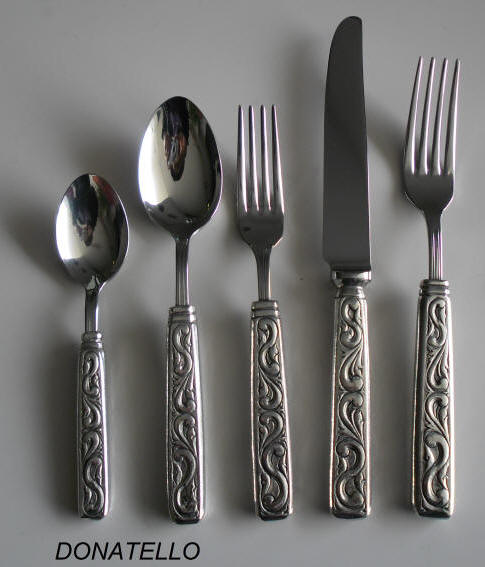
Donatello pewter
flatware by Valpeltro
Flatware Fashion
The handle design mainly drives
the look and attractiveness of the flatware although some of the
more contemporary designs for example Scandinavian flatware take
the whole piece into consideration as a free form item.
Your initial thoughts should be
on your existing tableware and what will match or complement
your dinnerware and stemware. Are you looking for a traditional,
classic or contemporary setting. The traditional look very much
suits those flatware patterns in silver and stainless in full
metal some of which go back the seventeenth century (rat tail,
bead, filet etc).
The last few years have seen
advances in design creativity in the handle and bolster designs.
These modern and classic designs make use of natural woods,
lacquer, and resins providing a myriad of colors and finishes
such as marble, mother of pearl, ivory and bamboo. These designs
will complement both fine china and contemporary dinnerware,
indeed natural wood in my opinion matches gold decorated china
as effectively as the more expensive sterling silver.
One of the
advantages is that they can, depending on the manufacture and
the finish, be dishwasher proof. We offer a sterling silver
collection by Robbe and Berking that is very unusually
dishwasher safe and can be found only in top end shops and is
collected by super yacht owners because of its nautical
connections and the fact that it is salt resistant.
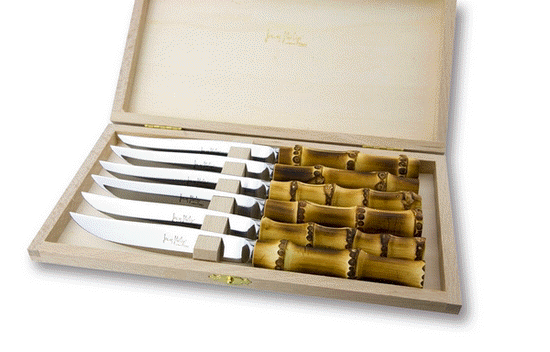
Natural bamboo by Jean Philip
Flatware Settings
The standard flatware 5 piece settings consists of a table
knife, table fork, dessert/soup spoon, dessert fork, and tea
spoon. Be wary in that European and US flatware settings can
differ. It is advantageous to have flatware made to order in
that you can select whatever combination you prefer. The deep
rounded soup spoon common in the UK and US is not made or used
in continental Europe.
Most
companies have a wide choice of serving and additional
individual pieces such as butter knives (always an attractive
and useful item), cheese knives, and fruit knives. Match the
number of settings to your dinnerware setting and add one or two
to cover losses (it is surprising how often pieces disappear).
Always have at least two serving spoons, however, for serving
utensils antiques can be just as effective.
You should also consider whether
you need matching steak knives (Jean Philip offer steak knives
as part of their flatware ranges) or ones that complement your
flatware choice. There are a number of specialist steak knives
on the market such as Laguiole and Chateaubriand which are
extremely attractive and very effective.
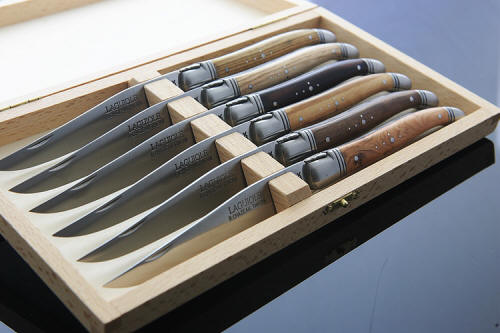
Laguiole steak
knives in mixed wood by Jean Philip
Conclusion
Take a look at the bigger design
picture, does it match or complement, does it feel right and
remember it’s always best to purchase quality.
|



 is secured by